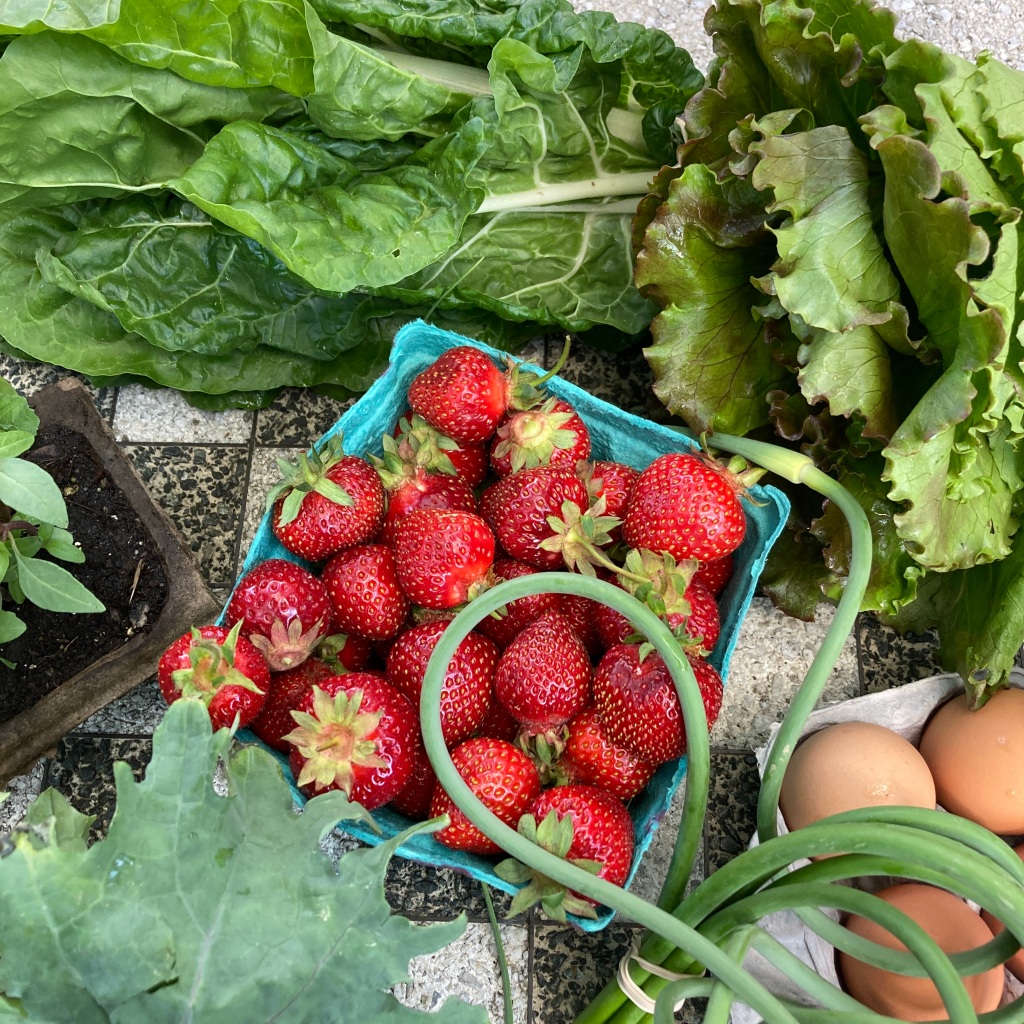
VEGGIES
sweet corn
arugula
lettuce
fennel
onions
garlic
peppers (fryers or bells)
yellow wax beans
cherry tomatoes
medium tomatoes
sungold tomatoes
basil or cilantro to pot
FRUIT
bartlet pears
VEGGIES
sweet corn
arugula
lettuce
fennel
onions
garlic
peppers (fryers or bells)
yellow wax beans
cherry tomatoes
medium tomatoes
sungold tomatoes
basil or cilantro to pot
FRUIT
bartlet pears
→ Leave a CommentCategories: Uncategorized
Here are some tidbits from Nancy & Alan of CSA Pastured Meat & Poultry:
The preparation for fall and winter has just about begun so it is really great that we finally have gotten our hay all done! We have about half our acreage baled in the white wrapped baleage, fermented like sauerkraut. The other half is dry round bales a good 4 feet tall and wide. We also have 5 other farms where we hay and with our old 1950’s tractors going at the full speed of 12 miles per hour, one of the farms takes about and hour to drive to and a bit more with a fully loaded hay wagon to come back. So right now we have bales all over and we’ll be driving back and forth between fields bringing hay home this week. Thankfully the last week of weather fully cooperated with the haying program (it can’t rain on the loose hay) and we got it all done nicely.
We are cleaning out the root cellar to begin stacking in potatoes, our braided onions and lots of bunches of great garlic! It is hard to believe the season has rolled around already and is starting to be dark very early and getting cooler every night. The wild apples are ripening everywhere, the pears in our yard and our neighbor’s yard too are falling from the trees and the fall raspberries are just luscious! Harvest time – it seems the only time it is not really busy around here is winter but you can make yourself busy then too!!
→ Leave a CommentCategories: Uncategorized
This week’s share is looking like it will include assorted tomatoes, leaf lettuce, cabbage, fennel (better start looking up recipes now!), cucumbers, onions, garlic, beets, a selection of herbs, and either peppers or eggplants or squashes or broccoli.
→ Leave a CommentCategories: Uncategorized
Sorry guys, no newsletter this week. But we do have this piece of cool news from Ted:
The organic inspector came on Tuesday. Inspections, which precede certification, take place annually. The inspector and I toured our packing shed to make sure questions of food safety had been adequately addressed; we looked over the equipment in our barn to make sure it contained all the tools necessary to the practice of organic farming; and we checked out our inventory of biological pesticides. We walked all over our farm, and talked at length about our farming practices. The organization that we are certified by – Certified Naturally Grown – wants to know how we manage insects when we cannot use insecticides (primarily through crop rotation and the use of biologicals, I told them). They want to how we deal with diseases when we can’t use fungicides or bactericides (again, primarily through crop rotation, but also through use of disease-resistant cultivars, good sanitation, and occasional copper sprays, I explained). They want to know how we control weeds without the use of herbicides (crop rotation plays a role here, too, as does cover cropping and the use of transplants, I said, but our primary tools are tractor cultivating, hand hoeing, and mulching). And they want to know how we grow vegetables without the use of synthetic fertilizers (I told them we use compost, primarily, along with a few approved soil amendments and cover crops).
When done well, the farm inspection is a learning opportunity. Chuck, the inspector, and I shared ideas about varieties (he told me that the first good tomato varieties with resistance to late blight are just a year away), crop production practices (I showed him our onions on biodegradable mulch), and equipment (we both marveled at our new stone burier).
Certified Naturally Grown (CNG) uses a farmer-to-farmer approach to certification. The inspectors are member-farmers or Extension agents. Chuck, a farmer (and, as it turns out, part time Extension agent) from the next county south inspected our farm. The rationale behind the farmer-to farmer approach to inspection is simple. As CNG farmers, we have a vested interest in maintaining the integrity of the program – we won’t want it to be spoiled by allowing non-organic farmers to make false claims. We know how hard and expensive it is to farm organically – it would be foolish for us to let non-organic growers slip through. We can tell the difference between an organic and a conventional farm – we won’t be easily duped. Every CNG farmer is expected to inspect another member farm, but not the farm belonging to the farmer who inspected his farm.
We have always farmed organically. Certification means that you needn’t take just our word for it. It means that we are part of a growing community of farmers committed to organic farming practices.
Best wishes,
Ted
→ Leave a CommentCategories: Uncategorized
VEGGIES
lettuce
celery
corn
tomatoes
potatoes
cucumbers
hot wax peppers
bell peppers
onions
basil
FRUIT
peaches
→ Leave a CommentCategories: Uncategorized